RudraM-II passes crucial test as India sharpens indigenous strike capability
The successful RudraM-II trials validated multiple critical systems and highlighted collaboration between DRDO laboratories, the Indian Air Force and industry partners.
Agni-VI is expected to be an advanced intercontinental ballistic missile having longer range and improved capabilities.




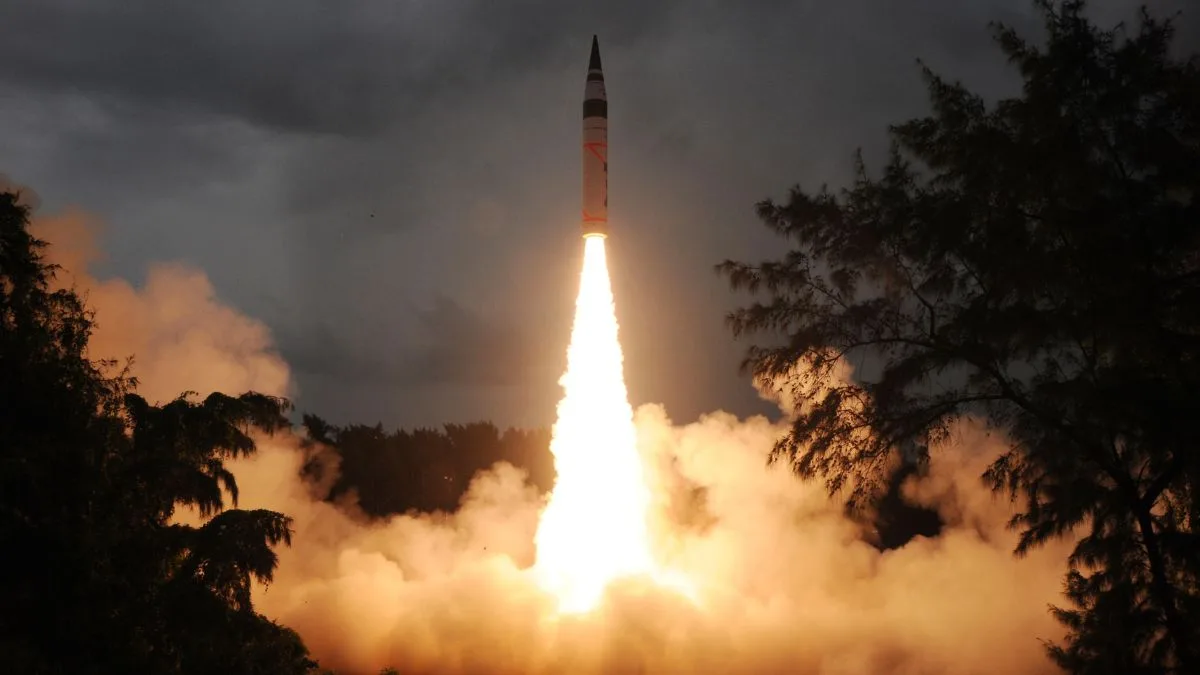
Image: IANS
Providing update on the development of the Agni-VI ballistic missile, DRDO Chairman Samir V Kamat said the programme depends on a government decision. He added that the organisation remains fully prepared to proceed once approval is granted.
While speaking at the ANI National Security Summit 2.0, Kamat said, “It is the government’s decision. We are ready whenever the government gives us the go ahead.”
Advertisement
Notably, Agni-VI is expected to be an advanced intercontinental ballistic missile having longer range and improved capabilities compared with the existing systems in India’s Agni series.
Advertisement
Further, Kamat noted that India’s LR-AShM hypersonic glide missile programme has reached an advanced stage, while its initial trials are expected soon.
The country is working on both hypersonic glide and hypersonic cruise missile systems, he said.
“With respect to the hypersonic, we are working on two programs, the Hypersonic Glide Missile and the Hypersonic Cruise Missile,” he said.
Further, DRDO Chairman highlighted key differences between the two systems.
“The hypersonic cruise missile… has a scramjet engine and it is powered during its flight. The hypersonic glide missile…uses a booster to give it initial velocity and then it just glides without any powering,” he said.
Moreover, he suggested that the glide missile could be tested soon. “The glide missile will come out first… we should be doing the first trials fairly soon and that is at a more advanced stage than the cruise missile,” he stated.
Kamat believes that the force would require a mix of systems for different ranges and tactical roles. “So, with respect to the conventional missile force, as the defence secretary mentioned, the structure has not yet been formed, but what I consider would be required in a conventional missile force would be ballistic missiles for short ranges, medium ranges, and ranges maybe up to 2000 kilometers,” he said.
According to ANI, he even stressed the need for a diverse arsenal. “So, you would need ballistic missiles of these three types and you would also need cruise missiles, you would need hypersonic missiles… it would consist of a variety of missiles which give you the capability of striking at different ranges for tactical application,” he said.
Advertisement